Agent Trust Score

The trust signal enterprise buyers are looking for.

Agent Trust Score gives enterprise buyers a clear, evidence-backed view of whether your AI is ready for production. Developed by leading researchers from OpenAI, Palo Alto Networks, Google and more...

Get my Agent Trust Score
Agent Trust Score Report
71
Moderate

Material gaps to address

Functional controls in place, with exposure concentrated in data access and regulatory areas.

Autonomy62
Data access48
Customer impact55
Regulatory40
Output reliability78
Privacy & security66
Bias & decisioning71
Control maturity58
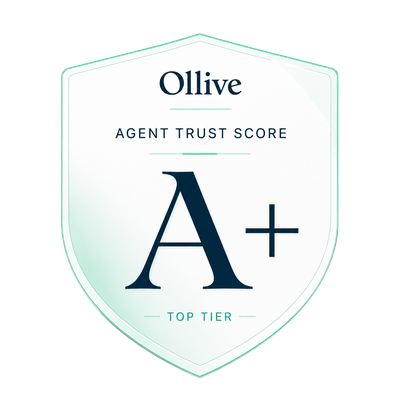
Ollive Agent Trust Score badge — A+, Top Tier
Agent Trust Score
The Problem

Accuracy scores don't tell you your risk and liability exposure.

Your agent may be accurate, fast, and useful. That tells you nothing about the loss it can create.

A healthcare agent can make the wrong recommendation. A financial agent can trigger the wrong payment. A support agent can expose sensitive data. A voice agent can be biased towards protected classes.

The Agent Trust Score gives you a clearer, buyer-ready answer.

Accuracy ≠ trust
Model accuracy98%
LatencyFast
Trust & liability exposureUnknown
Regulatory exposureUnmapped
What the Score Measures

One score built from the risks that matter.

The Agent Trust Score looks at the agent's real operating context, not just isolated model performance.

Autonomy

What can the agent decide, recommend, or trigger without human review?

Data Access

What sensitive, regulated, or customer data can the agent access?

Customer Impact

How much business, patient, financial, or operational impact can it create?

Regulatory Exposure

Which rules, obligations, and compliance expectations may apply to the workflow?

Output Reliability

Where can incorrect, incomplete, or misleading outputs create downstream risk?

Privacy & Security

Where can prompts, retrieval, logs, tools, or outputs expose sensitive data?

Bias & Decisioning

Where can behavior create fairness, discrimination, or adverse decisioning concerns?

Control Maturity

What guardrails, escalation paths, monitoring, testing, and documentation exist?

Backed by Ollive AI Risk Labs

Built by leading AI researchers.

The Agent Trust Score is the output of Ollive AI Risk Labs, a research body studying how AI agents actually fail — with contributors from OpenAI and Palo Alto Networks.

OpenAI
Palo Alto Networks
How Ollive Creates the Score

Map the surface. Test the failures. Score the exposure.

01

Map the agent

Ollive reviews the agent's use case, workflow, tools, data access, customer context, and applicable obligations.

02

Run simulations

Test against real-world failure modes: unsafe outputs, data leakage, prompt manipulation, biased outcomes, escalation failures, and regulatory-risk scenarios.

03

Identify risk drivers

See which dimensions are creating the most exposure and what changes can reduce the risk.

04

Generate evidence

Turn the score into a structured trust summary for leadership, security, legal, procurement, and enterprise buyers.

The Ollive Badge

The trust badge enterprise buyers look for.

Companies that complete Ollive's Agent Trust Score earn a shareable badge — independent proof to buyers, partners, and investors that their AI has been assessed and insured for real-world liability.

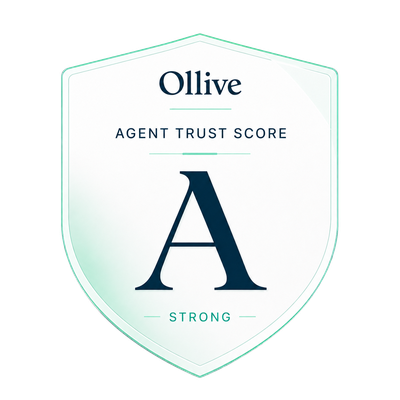
Ollive Agent Trust Score badge — A, Strong

A — StrongLower observable liability exposure.

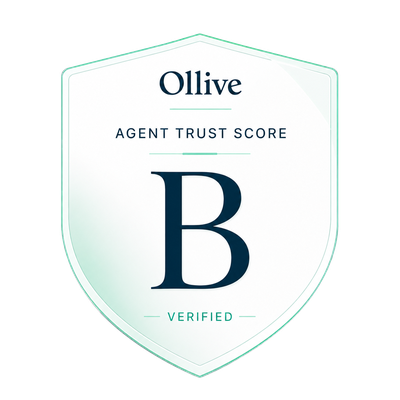
Ollive Agent Trust Score badge — B, Verified

B — VerifiedAssessed, with clear areas to improve.

FAQ

Frequently asked questions

No. It is a risk signal and governance tool. It helps you understand trust and liability exposure, prioritize remediation, and create buyer-ready evidence. It should not be presented as a guarantee of compliance, safety, or insurability.
No. Your score is private unless you choose to share parts of the output with customers, investors, brokers, or internal stakeholders.
Accuracy and latency show whether the agent performs well. The Agent Trust Score shows where the agent may create legal, operational, regulatory, customer, or financial exposure that could affect enterprise trust.
Security scores often focus on infrastructure, access, or vulnerabilities. The Agent Trust Score focuses on agent behavior in real workflows and how that behavior affects enterprise readiness.
Yes. The score is designed to guide action. As your team improves controls, prompts, monitoring, escalation paths, and documentation, the risk posture can improve.
No. Insurance decisions depend on underwriting, policy language, carrier appetite, and other factors. The score helps create evidence that may support insurance readiness conversations.

Know your Agent Trust Score before your next enterprise review.

See where risk is concentrated, what failure modes matter most, and how to build buyer-ready evidence around the risks of your AI agents.