AI Risk Evals

Evaluate the liability your AI agents create in production.

Ollive maps your agents against regulations, contracts, compliance obligations, escalation rules, and real-world failure modes — then helps you test, reduce, and monitor risk before it reaches your customer.

Ollive — Risk Evals
Live agent behavior Monitoring
Intake agentStable
Claims assistantDrift
Support agentWatching
Escalation missed on high-risk case 2m ago
New regulation mapped to workflow 14m ago
The Shift

Risk evaluation moved from policy documents to production behavior.

Enterprise buyers do not only want to know what your AI policy says. They want to know how your agents behave when real users, real data, changing regulations, and edge cases hit production.

Static policy vs. live behavior
AI_Policy_v3.pdfStatic
Annual risk reviewPoint-in-time
Live agent behaviorRuntime
Drift & control gapsTracked
What Ollive Gives You

One place to see, test, and prove AI risk.

Agent Risk Map

Map agents, prompts, tools, data flows, customer deployments, and high-risk workflows.

Regulatory Risk Mapping

Identify which regulations, frameworks, customer obligations, and contractual expectations may apply to each agent.

Risk-Focused Evals

Run simulations against liability and compliance scenarios buyers care about — from unsafe advice to data leakage and biased outcomes.

Actionable Recommendations

Get practical recommendations your engineering team can use to strengthen prompts, guardrails, escalation paths, and monitoring.

Buyer-Ready Evidence

Produce reports that show what was tested, what failed, what was fixed, and what controls are in place.

See your risk surface

Turn agent behavior into a clear, buyer-ready risk signal.

Get my Agent Trust Score
How It Works

From API access to risk reduction.

1

Connect

Give Ollive a safe way to interact with your agent — an API endpoint, staging environment, test user, or observability data.

2

Map the liability surface

Ollive maps the agent's use case, tools, data access, deployment context, customer obligations, and applicable regulatory-risk areas.

3

Run risk-focused evals

Ollive simulates high-risk user behavior, regulatory scenarios, adversarial prompts, edge cases, compliances, internal policies and real-world failure paths.

4

Reduce the risk

Your team receives prioritized findings and recommendations to improve prompts, controls, guardrails, escalation paths, and monitoring.

5

Win enterprise trust

Get your Agent Trust Score for enterprise reviews, policy gap discussions, and insurance readiness conversations.

Why Continuous Evals Matter

A point-in-time report isn't enough for agents that keep changing.

AI agents change as prompts, tools, customer workflows, regulations, and production usage evolve. A one-time assessment sets a baseline — continuous evals show whether risk is improving, drifting, or creating new exposure.

Agent behavior drift Output reliability risk Privacy & data exposure Unsafe recommendations Escalation failures Tool-call risk Bias & decisioning risk Regulatory exposure Contractual obligation risk
Enterprise security review
Which rules apply?Answered
How is AI risk tested?Answered
How are controls monitored?Answered
Deployment approvalCleared
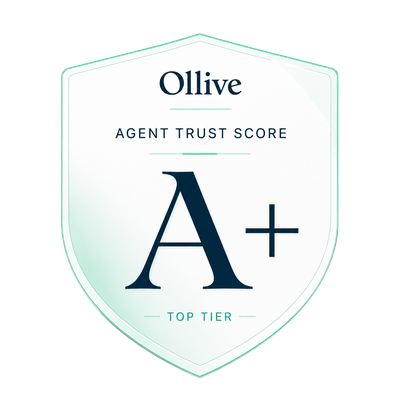
Ollive Agent Trust Score badge
Agent Trust
Score
Enterprise-Ready
Built for Enterprise Sales

Turn risk evals into a sales asset.

The strongest AI companies do not wait for legal or procurement to raise risk questions. They show up prepared.

Ollive helps your sales and customer teams explain which rules apply, how AI risk is tested, how controls are monitored, and how the company is preparing for liability conversations — so you compete against larger vendors that rely on brand reputation and existing enterprise trust.


AI Risk Evals + Insurance Readiness

The evidence layer for AI risk transfer.

Insurance readiness starts with knowing how your agents behave and which risks apply. Ollive connects continuous risk evals with regulatory and liability exposure so you can see where risk is concentrated, where controls need improvement, and where financial protection may be relevant.

Integrations

Plugs into the AI stack you already run.

Ollive evaluates agents built on the voice, model, and observability tools teams are already using — no rip-and-replace required.

Retell AI Smallest.ai Deepgram ElevenLabs Cekura Arize Langfuse
FAQ

Frequently asked questions

Compliance automation usually organizes policies, tasks, and evidence. AI Risk Evals assesses how AI agents behave in real-world workflows—mapping liability exposure, identifying regulatory obligations and potential compliance violations, testing high-risk failure modes, monitoring production risk, and generating evidence that enterprise buyers, auditors, and insurers can trust.
Ollive's core value is helping teams understand, reduce, and monitor risk. Depending on the implementation, customers can use findings to improve prompts, guardrails, escalation paths, and monitoring. We do not imply universal real-time blocking unless that implementation is explicitly enabled.
Ollive is built for agents that retrieve, recommend, summarize, classify, call tools, trigger workflows, or interact with customers — including voice agents, document agents, support agents, RCM agents, eligibility workflows, intake agents, financial assistants, and other enterprise AI Agents.
Not always. Ollive can start with a staging environment, API endpoint, or test user. For ongoing monitoring, teams can connect logs, traces, or observability data where appropriate.
Ollive looks at the agent's industry, use case, data access, customer workflow, geography, and contract obligations to identify the regulatory and liability areas that may matter. Those obligations inform the scenarios we test and the controls we recommend.
AI Engineers, Forward Deployed Engineers or AI Evaluation Engineers uses the findings from Ollive to fix prompts, guardrails, tools, controls, and monitoring. Product teams uses them to prioritize risk reduction. Sales and leadership teams use the findings to win enterprise buyer conversations.

Win enterprise trust with confidence.

Show enterprise customers your leadership in AI Risk management and how you mitigate risks to ensure AI Agents are ready for enterprise deployment.